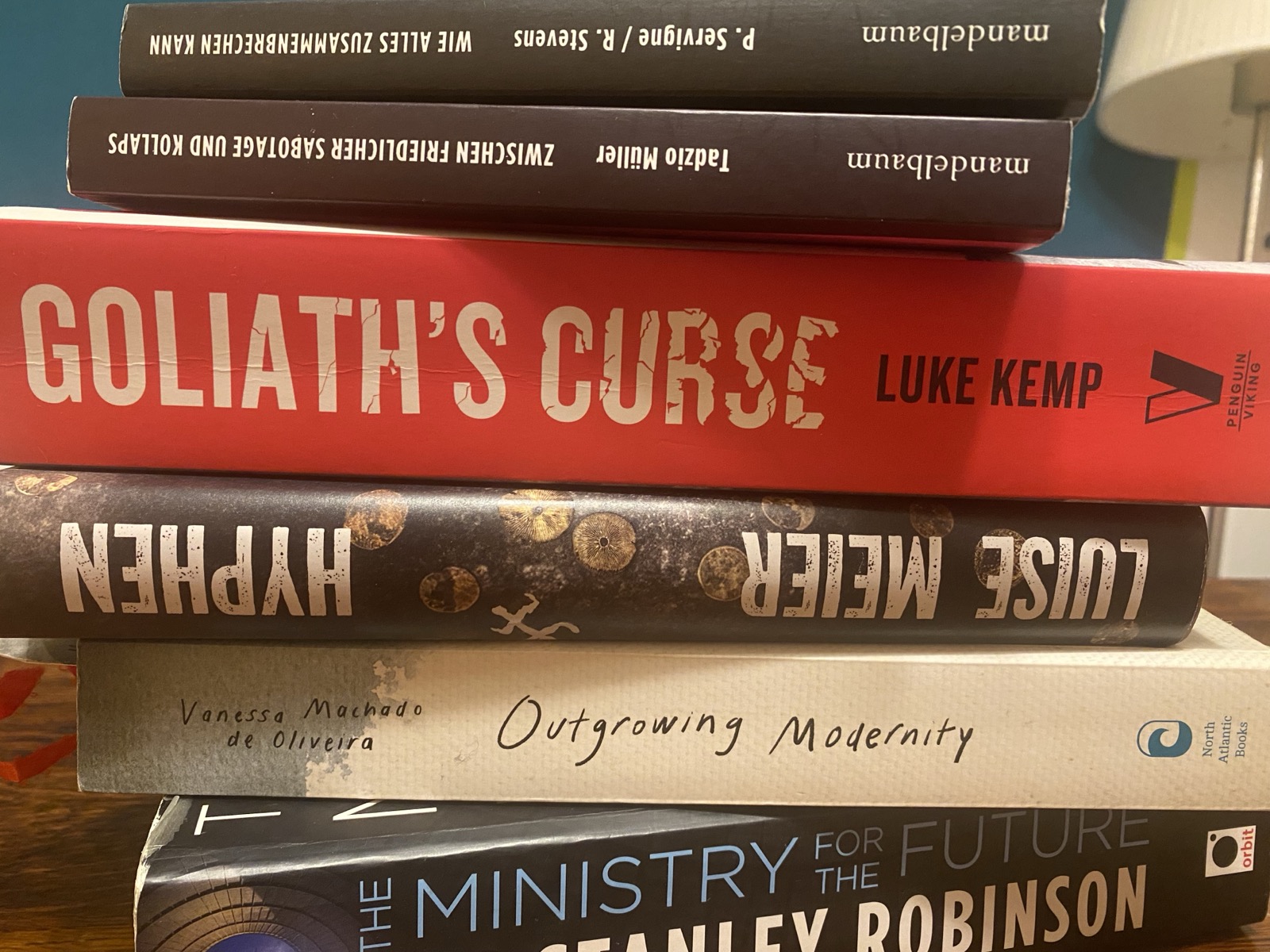
Sachbücher, Kollaps-„Workouts“ und Romane, die für mich wichtig, inspirierend, spannend oder alles gleichzeitig sind; unter anderem mit indigenen, historischen und politikwissenschaftlich / aktivistischen Perspektiven. Nach Erscheinungsdatum sortiert. Kaufen am besten bei der Buchhandlung um die Ecke oder ausleihen in der nächsten Bibliothek. 🙂 Stand: Oktober 2026
Sarah Wilson: i eat the stars (2026)
how to live fully and beautifully in a collapsing world

S. 195, Kapitel „pain“: „The problem is that our current models for dealing with loss and grief (such as the standard „five stages“ approach) are largely linear and work best when a death is conclusive. But when we are neither here nor there and the time of death is, well, becoming, I’m not sure there is such a fix. [Social Scientist Pauline] Boss doesn’t profess to resolve the paradox either. Instead, she offers ways to bear it, mostly based on finding meaning in staying in the paradox and the pain.“
S. 213, Kapitel „oh, and we can dance!“: „When we dance it is said we are processing despair, grief, shame, terror, fear at a biological level. It enables us to stay with the pain, to express it, to bear it, and in such a way that it can then pass through us. Dance, you might say, is a despair composter.“
Reinlesen: https://www.thalia.de/shop/home/artikeldetails/A1076883753
Luke Kemp: Goliath’s Curse (2025)
The History and Future of Societal Collapse
S. 273:. „Some colonized countries did not collapse, but nonetheless experienced terrible hardship. [….] Perhaps because of cases like India, colonization is often strangely absent from most discussions of societal collapse. Apart from the few cases where an empire quickly unravelled – such as the Aztec and Incan – it is conspicuously missing in most coverage. That is because colonization perversely boosted economic growth and urbanization, even while it ate away the culture, simplified the economy, and murdered millions. Colonization wasn’t just a matter of collapse and genocide; it also marked the global triumph of Goliath.“
Vanessa Machado de Oliveira: Outgrowing Modernity (2025)
Navigating Complexity, Complicity, and Collapse with Accountability and Compassion
S. 40: „[It] is not a matter of belief or hope but a matter of faith – which, in this context, is trust in what is unknowable. Thus, we have been taught to trust in the possibility (however tiny it might be) that humanity can (at some level or dimension) heal from the dis-ease of separation. We have also been advised to be fiercely gentle and infinitely patient and to develop a strong sense of humor (especially for laughing at ourselves) because the journey of healing will invariably involve the medicines of shadows, sorrows, contradictions, and the absurd.“
Luise Meier: Hyphen (Roman, 2024)

S. 9, Bericht der Protokollant*innen: „Der Großteil unserer Nachbar*innen beschreibt sich trotz aller Entbehrungen und traumatischen Erfahrungen, besonders in den ersten Monaten und Jahren, heute als zufriedener als vor 2025. Dafür gibt es verschiedene Gründe, der am häufigsten angegebene ist allerdings die enge Kooperation in der Gemeinschaft und die ganz eindeutig damit verbundene Zunahme von Selbstwirksamkeit oder »Sinn« sowie die Abnahme von Erfahrungen der Konkurrenz und Isolation.“
Tadzio Müller: Zwischen friedlicher Sabotage und Kollaps (2024)
Wie ich lernte, die Zukunft wieder zu lieben

S. 242: „Die zentrale Zukunftsfrage ist dementsprechend nicht mehr „Können wir den Klimakollaps noch verhindern?“, since we can’t. Aber wir können noch dafür sorgen, dass die Netzwerke, die sich bilden werden, um alltägliche Notwendigkeiten zu organisieren, nach solidarischen Prinzipien organisiert sind, anstatt nach, sagen wir mal, national-patriotischen. Weil Nazis immer scheiße sind. Auch und vor allem im Kollaps.“
Kim Stanley Robinson: The Ministry for the Future (Roman, 2020; auf deutsch 2021)

S. 7: „Following the great Indian heat wave, the emergency meeting of the Paris Agreement signatories was fraught indeed. The Indian delegation arrived in force, and their leader Chandra Mukajee was excoriating in her denunciation of the international community and its almost complete failure to adhere to the terms of the agreement that every nation on Earth had signed. Reductions in emissions ignored, payment into investment funds that were to be spent on decarbonization not paid—in every way the Agreement had been ignored and abrogated. A performance without substance, a joke, a lie. And now India had paid the price. More people had died in this heat wave than in the entirety of the First World War, and all in a single week and in a single region of the world.“
Pablo Servigne, Raphael Stevens: Wie alles zusammenbrechen kann (2015 im Original, auf deutsch 2022)
Handbuch der Kollapsologie

S. 38: „Zwischen uns und nahen Freund*innen, die ihre Vorstellungswelt vom Weitermachen und linearen Fortschritt beibehalten und unter allen Umständen verteidigen wollten, tat sich ein Abgrund auf.
Im Laufe der Jahre entfernten wir uns deutlich von dieser festgelegten Doktrin, nach welcher die öffentliche Meinung aus den weltpolitischen Nachrichten einen Sinn destillieren will. Machen Sie selbst die Probe: Hören Sie nun selbst die Sie erreichenden Informationen aus der Perspektive des Zusammenbruchs, und Sie werden sehen, das hat nichts mehr mit dem zu tun, was Sie bisher kannten! Es ist nun mehr denn je zu einem fremdartigen Gefühl geworden, dieser Welt anzugehören, aber gleichzeitig von dem vorherrschenden Bild getrennt zu sein, das sich die anderen noch immer von ihr machen.